By using Google Forms, it enabled me to collect data that I can present in both graphical forms and in words. I asked questions that supplied both quantitative and qualitative data to make my research as detailed as possible.
Using Google Forms is an extremely useful medium to find out what people are interested in watching. The aim of my questionnaire is to find out what people would like to watch including the genre and finding out who my particular target age group is. It helps me find out who wants to watch movies, where they watch them and how they found out about particular films, this will give me a good indication on how to promote my movie and on what kind of platforms.
The questions I intend to ask:
(opening) I would be grateful if you complete this short survey on your particular film preferences
What gender are you?
- Female
- Male
- Prefer not to say
What age are you?
- Under 35
- Over 35
- Prefer not to say
Where to you watch films?
- Cinema
- DVD
- Amazon/ netlfix
- Other streaming platforms
What genre of film is your favourite? (pick as many as you want)
- Comedy
- Romance
- Thriller
- Horror
- Mystery
- Action
- Science fiction
- Drama
- Chick flick
- Other
Identify 3 recent films you have enjoyed watching:
-
-
-
Would you watch a trailer before watching the film?
- Yes
- No
Have you seen any of the following trailers or films?
1. A Simple Favour
2. Get out
3. Joker
What is the most likely reason you would go to see a film?
- Director
- Actor
- Sequel
What platforms do you use to find out about films?
- Cinema
- Social media
- Website
- Television
Are you influenced by the following (pick as many as you want):
- Reviews
- Recommendations
- Social media
- Talk shows
(end) Thank you for completing the survey!
Thursday, November 21, 2019

Tuesday, November 19, 2019
UNDERSTANDING HEGEMONY
Hegemony is the concept that media continually reproduces images of a dominant group as superior and powerful. In Western Society, the dominant group is middle class, white males, because the media is predominantly produced by this group type, they therefore tend to represent this middle class, white males as more superior and show the rest of society (working class, LGBT, disabled, female) as less powerful and therefore inferior. The key to hegemony though, is that it is so subtle, so much so that even the white man making the media don't even realise they are doing it, and nobody challenges it. It establishes hierarchies in in society that get reflected back to us in the media and it becomes normal. This theory can be seen as a chance to think about the current status quo and where we are now in terms of how audiences interact with or are influenced by the media.
The magic bullet effect theory and hypodermic needle theory are two behaviourist models that analyse the effect of the media. The magic bullet theory is the idea that the media fires messages into our brains and we are passive consumers of the media who believe everything we are told. Similarly, the hypodermic needle theory is that media messages are injected into our bloodstream. Both these ideas are 'behaviourist' or 'passive audience' theories which show that the media have a direct impact on our behaviour. However, this can be seen as untrue and almost ridiculous because of examples such as Donald Trump. who blamed violent video games for the reason why high school shootings occurred in Florida, instead of acknowledging the real problem of the American gun laws. This tragedy inspired the March for our Lives movement where. thousands of students in Washington marched to call for gun reform. This evidently shows that teenagers especially are not as passive as thought and can see the real issues and fight for what they believe in.


The uses and gratifications theory (also known as Maslow's needs and motivation theory) suggests that audiences have control over the media they consume and pick and choose the media they want based on their needs (uses) and desires (gratifications). This is completely different to the magic bullet theory, as here the consumer can go through and choose exactly what they want and reject what they don't like the look of.
Hegemony is continuously being shown in the media. Statistics show that women make up over half the country, yet only 13% of working film directors are women in the UK. BAME people make up 14% of the population but according to Ofcom, only 12% of the employees in this industry are from this background though! Disabled people are very underrepresented, which is a huge issue which is caused due to the stats not telling us about these people's backgrounds. Over half (54%) of top journalists were educated in private schools when only 7% of children in UK actually go to private schools. A further 33% of journalists were at selective grammar schools and only 14% attended comprehensive schools which is where 90% of children are now educated. This shows it is not easy for the average lower class or working class person to get a job in the media, let alone the underprivileged, transgender, ethnic minority groups. When the lives of these groups are just depicted in the news and written into stories or framed by directors, then these representations are likely to be constructed from a middle class white privileged man. However, we could challenge it, in this day and age we don't challenge the ideas fed to children that all doctors and pilots are rich white men and that barbies are white, blonde with blue eyes. If we don't challenge this, then we are consenting to a corrupt system.

Pluralism is the idea that in order to change the way we all think, we need to see many varied representations of people from different social groups, rather than repeated stereotypes we continuously see. This challenges hegemony as it takes out the stereotypes, for example the Legally Black campaign. This campaign was where they allowed black people to replace big white actors in successful movies like Harry Potter and Doctor Who. Pluralism is definitely desirable to people as people aren't used to see ethnic minorities on posters of some of the most successful films created. Therefore, this widens people's views and challenges the stereotype view of media.


Friday, November 15, 2019
PLANNING: MY TARGET AUDIENCE
When coming up with my opening sequence, I realised I needed to research my target audience and understand what type of people they are. This included their age, gender, ethnicity and social class. It is important for me to understand their media needs so I am able to produce a product that is something they will watch and enjoy. Lastly, in order to market our movie, I needed to find I way to reach the target audience. I will show how my research I found has influenced my planning by answering the questions below and including pictures to support my answers.
1. Who is my primary target audience?
British females and males aged from 15-34 who enjoys watching movies with drama and suspense.

2. What kind of films and television are they likely to prefer?
After doing some film research we discovered that the film 'A Simple Favour' would seem like a popular movie for our target audience. It is a story about a lady trying to unravel the mystery behind her friends disappearance and along the way they found out secrets about her that no one knows. I think this movie is extremely good to relate to our movie opening as ours will be about a famous lady who tries to escape her scandal so leaves the country to not be discovered in huge detail.

3. What platforms do they choose to watch films and where are they likely to see information about films?
Our audience is most likely to enjoy watching a movie in a niche market cinema such as Everyman or Curzon as they can experience the true richness and quality of it while also having an incredible experience. However, we feel that our audience will also enjoy we experiencing movies online on streaming websites like Netflix, Amazon or Sky and they may start to use other streaming services like Disney+

4. What brands do they prefer?
my audience profile

5. What makes my film stand out from the competition?
We are focusing on how famous people suffer in the spotlight and how being famous isn't as glamorous as we all dream it to be.
6 . Why should my audience watch my film? For example: Total Film / Empire / Cinema Scope / Slant / Sight and Sound says: Most powerful psychological thriller since Don't Look Now!
My audience should watch my film because even though there are films that also look at the lives of famous people such as musicians, mine differentiates as it looks at the personal lives of a celebrity and how they are effected and how it effects their family. It gives an in look on the lives we are hidden from and doesn't glamorise being famous. Its a personal, emotional, suspenseful film that is a must see!
Thursday, November 7, 2019
RESEARCH: ART OF THE TITLE- 11.22.63
11.22.63

This title sequence has a series of visual codes all of which are taken from the life of a police investigator who has a process to record, analyse and display evidence throughout a detailed and important investigation.
The sequence uses different types of innovative and thoughtful film work, including some live action, newspaper cutting and still photographs. The title sequence first starts with a model recreation of the JFK assassination which is one of the most well-known unsolved murder mysteries in history. Mise-en-scene and multiple different shot types are used to make the title sequence more intriguing and a better watch for viewers.
The editing of the title sequence is extremely intricate and well thought out, so through this fast pace and continuous editing the audiences are very gripped and the continuity of the editing makes it easy for viewers to travel through the sequence rapidly and understand what is going on. The audience is hooked immediately through the piece of red string that comes the car model, this string links together all the pieces of evidence to the police board. The start of the title sequence begins by the audience looking through a magnifying glass to then unravel all of the mystery. The use of this stereotypical visual code, immediately makes the audience aware what kind of series it will be.
The editing is fast paced and connotes urgency, hard cuts are used as the camera travels around showing all the evidence from the murder. This could connote the restless mind that is trying to deconstruct the murder and try and solve the case. This is extremely effective in showing how curious the mind is and how the hard cuts connote all the constant thoughts going on in their mind.
Specific shot types are used in the tile sequence such as the low angle shot from the car window shows the point of view of certain people connoting which point of view the audience are looking from. This shot is followed by the red string leading from the car into a building. This is extremely effective to create an immersive quality for the audience and it clearly shows the detective trying to unpick the murder. Following on from this, the opening sequence does a very good job at drawing the audience in and keeping them engaged the whole way through, this is a prime function of an opening sequence.
Not only this, but important dates are also used to create authenticity and make the title sequence of higher quality. By showing a number of different newspapers in the police office pin board in extreme close up shots reflects how important the murder was as multiple newspapers have headlined it, titles included "Kennedy Killed" connoting how tragic and out of the blue the death was.As the title sequence unfolds, the audience seem to almost be in the footsteps of the detective, as it feels as if we are following the assassin around to where he prepared the murder and the build up to it. The open suitcase on the bed is remembered by the viewers due to it being lit up by a spotlight connoting its importance. Within the case lies clothes, letters, pens, notebooks and the gun. The gun is placed in the centre of the suitcase and is on top of everything else, connoting its importance and showing the audience this must be the gun that killed Kennedy. The use of the visual codes of a gun, presents to the audience that the genre must be a thriller/ mystery/ action movie.
This specific title sequence follows all genre conventions including names of actors, producers, directors, writers and many more. In addition, the soundtrack is intriguing and the orchestral, dramatic music drives the action forward. The xylophones rhythm adds a sense of eerie and mystery into the atmosphere, which makes it extremely effective and makes the viewers want to watch on and even watch the movie itself. The further on the title sequence goes, the faster and more dramatic the music becomes once again adding suspense for the viewer. The final clips of the clock ticking transitioning to an extreme close up of the riffle shooting a bullet. At this point the name of the movie is suddenly revealed, in old typewriter font. It ends by the final dot in 11.22.63 turning red, connoting the murder and the blood from where he was shot.
This title sequence has a series of visual codes all of which are taken from the life of a police investigator who has a process to record, analyse and display evidence throughout a detailed and important investigation.
The sequence uses different types of innovative and thoughtful film work, including some live action, newspaper cutting and still photographs. The title sequence first starts with a model recreation of the JFK assassination which is one of the most well-known unsolved murder mysteries in history. Mise-en-scene and multiple different shot types are used to make the title sequence more intriguing and a better watch for viewers.
The editing of the title sequence is extremely intricate and well thought out, so through this fast pace and continuous editing the audiences are very gripped and the continuity of the editing makes it easy for viewers to travel through the sequence rapidly and understand what is going on. The audience is hooked immediately through the piece of red string that comes the car model, this string links together all the pieces of evidence to the police board. The start of the title sequence begins by the audience looking through a magnifying glass to then unravel all of the mystery. The use of this stereotypical visual code, immediately makes the audience aware what kind of series it will be.
The editing is fast paced and connotes urgency, hard cuts are used as the camera travels around showing all the evidence from the murder. This could connote the restless mind that is trying to deconstruct the murder and try and solve the case. This is extremely effective in showing how curious the mind is and how the hard cuts connote all the constant thoughts going on in their mind.
Specific shot types are used in the tile sequence such as the low angle shot from the car window shows the point of view of certain people connoting which point of view the audience are looking from. This shot is followed by the red string leading from the car into a building. This is extremely effective to create an immersive quality for the audience and it clearly shows the detective trying to unpick the murder. Following on from this, the opening sequence does a very good job at drawing the audience in and keeping them engaged the whole way through, this is a prime function of an opening sequence.
Not only this, but important dates are also used to create authenticity and make the title sequence of higher quality. By showing a number of different newspapers in the police office pin board in extreme close up shots reflects how important the murder was as multiple newspapers have headlined it, titles included "Kennedy Killed" connoting how tragic and out of the blue the death was.As the title sequence unfolds, the audience seem to almost be in the footsteps of the detective, as it feels as if we are following the assassin around to where he prepared the murder and the build up to it. The open suitcase on the bed is remembered by the viewers due to it being lit up by a spotlight connoting its importance. Within the case lies clothes, letters, pens, notebooks and the gun. The gun is placed in the centre of the suitcase and is on top of everything else, connoting its importance and showing the audience this must be the gun that killed Kennedy. The use of the visual codes of a gun, presents to the audience that the genre must be a thriller/ mystery/ action movie.
This specific title sequence follows all genre conventions including names of actors, producers, directors, writers and many more. In addition, the soundtrack is intriguing and the orchestral, dramatic music drives the action forward. The xylophones rhythm adds a sense of eerie and mystery into the atmosphere, which makes it extremely effective and makes the viewers want to watch on and even watch the movie itself. The further on the title sequence goes, the faster and more dramatic the music becomes once again adding suspense for the viewer. The final clips of the clock ticking transitioning to an extreme close up of the riffle shooting a bullet. At this point the name of the movie is suddenly revealed, in old typewriter font. It ends by the final dot in 11.22.63 turning red, connoting the murder and the blood from where he was shot.
PRELIMINARY EXCERCISES
Shot types:
I researched different types of camera angles and shot types by exploring Daniel Chandler's website 'The Grammar of Television and Film'. I used my iPhone when practising these skills, here are some examples:


Canted angle shot: Tilted/Canted angle shots are used in films that want to create suspense, it is used to create the sense of unease in the viewer.

Low level shot: the camera is below the character, exaggerating his or her importance


Continuity editing:
Close up (CU): A picture which shows a fairly small part of the scene, such as a character's face, in great detail so that it fills the screen

Extreme close up (XCU): shows a small part of the scene like a characters face. Often forehead to nose

Medium long shot (MLS): in the case of a standing actor, the lower frame line cuts off his feet and ankles

Medium shot (MS): the setting and actor roughly occupy the same amount of screen

High level shot: the camera looks down at a character, making the viewer feel more powerful than him or her

Canted angle shot: Tilted/Canted angle shots are used in films that want to create suspense, it is used to create the sense of unease in the viewer.

Low level shot: the camera is below the character, exaggerating his or her importance

Birds eye shot:

Continuity editing:
Friday, November 1, 2019
PRODUCTION PRACTICE: TITLE SEQUENCE "A WHOLE WORLD IN A TABLE TOP"
Using the Emily Barkers song Nostalgia, we were set a brief of having to create a title sequence using only a table top and a few props to create part of a story which we felt related to the song.
After watching the title sequence Delicatessen, from 1991 created by JohnPierre Jeunet, I understood how important camerawork is to tell a story that sets the scene of a movie. My group used this title sequence as inspiration when creating our tabletop title sequence along with the song Nostalgia. My group covered a long table with a black table cloth and positioned all of our props in a unique and intricate order for people to understand our storyline. Our props included, alcohol bottles, old newspapers, old photographs of a couple, war photos of a man, old letters and even drugs. We felt these props went well with the title Nostalgia as our story was about a lady who lost her husband in war and therefore turned to a life of drugs and alcohol. The old photos of her husband and herself reflect her nostalgic thoughts. We did not just want our title sequence to finish here, so we also added live action into it which showed the young woman walking away and secretly meeting another person where she exchanges money for drugs and cigarettes, showing her husbands death has clearly affected her lifestyle hugely.
Personally, I think filming went extremely well for us. By filming the table multiple times to insure it was the best quality we could possibly make it, we were able to achieve a sequence at our full capability which I am proud of! However, I did face a few challenges when filming! As I was the person in charge of the camera, I found it a challenge to make the transition from each item flow easily and for the camera to flow very easily, after a few attempts I feel I was successful. Similarly, when filming the live action, we had to insure no modern features were shown in the shot (like a fire extinguisher), in order to achieve this, while I was filming, another member of my group followed behind making sure I did not capture the items while filming.


Once all the filming was completed, we used iMovie to piece it all together and edit it. Firstly, we imported the song onto iMovie and started it eight seconds in so the words matched what we were shooting. Obviously we had to incorporate our names into the title sequence so we carefully placed them in relevant parts of the sequence, for example when there was enough space on the screen so it was not all squashed together. We made sure the font related to our storyline, so we used an old, cursive font to make it seemed old fashioned and nostalgic. Our title sequence lasts just over one minute, which is long enough to tell a small story but short enough to keep it captivating and engaging! Equally, we kept it at this length for good practise as in our final piece, we will aim for our title sequence to be about a minute long.
When filming the live action scene, tracking shots, following shots, over the shoulder shots and shot reverse shots were used to achieve a realistic and suspenseful scene. When filming, a priority of ours was to make sure the background did not take up most of the shot but rather the main object or person did, this way it is less distracting and engages the audience in more.
Finally, we decided to name our show Saudade, translating to 'missing' from Portuguese to English, we thought was was very relevant to the theme of nostalgia and is unique and engaging to people to see. Our production company is called Moontale Studios, which we incorporated into our title sequence at the beginning, making it seem professional and of high standard.
SAUDADE
After watching the title sequence Delicatessen, from 1991 created by JohnPierre Jeunet, I understood how important camerawork is to tell a story that sets the scene of a movie. My group used this title sequence as inspiration when creating our tabletop title sequence along with the song Nostalgia. My group covered a long table with a black table cloth and positioned all of our props in a unique and intricate order for people to understand our storyline. Our props included, alcohol bottles, old newspapers, old photographs of a couple, war photos of a man, old letters and even drugs. We felt these props went well with the title Nostalgia as our story was about a lady who lost her husband in war and therefore turned to a life of drugs and alcohol. The old photos of her husband and herself reflect her nostalgic thoughts. We did not just want our title sequence to finish here, so we also added live action into it which showed the young woman walking away and secretly meeting another person where she exchanges money for drugs and cigarettes, showing her husbands death has clearly affected her lifestyle hugely.
Personally, I think filming went extremely well for us. By filming the table multiple times to insure it was the best quality we could possibly make it, we were able to achieve a sequence at our full capability which I am proud of! However, I did face a few challenges when filming! As I was the person in charge of the camera, I found it a challenge to make the transition from each item flow easily and for the camera to flow very easily, after a few attempts I feel I was successful. Similarly, when filming the live action, we had to insure no modern features were shown in the shot (like a fire extinguisher), in order to achieve this, while I was filming, another member of my group followed behind making sure I did not capture the items while filming.
Once all the filming was completed, we used iMovie to piece it all together and edit it. Firstly, we imported the song onto iMovie and started it eight seconds in so the words matched what we were shooting. Obviously we had to incorporate our names into the title sequence so we carefully placed them in relevant parts of the sequence, for example when there was enough space on the screen so it was not all squashed together. We made sure the font related to our storyline, so we used an old, cursive font to make it seemed old fashioned and nostalgic. Our title sequence lasts just over one minute, which is long enough to tell a small story but short enough to keep it captivating and engaging! Equally, we kept it at this length for good practise as in our final piece, we will aim for our title sequence to be about a minute long.
When filming the live action scene, tracking shots, following shots, over the shoulder shots and shot reverse shots were used to achieve a realistic and suspenseful scene. When filming, a priority of ours was to make sure the background did not take up most of the shot but rather the main object or person did, this way it is less distracting and engages the audience in more.
Finally, we decided to name our show Saudade, translating to 'missing' from Portuguese to English, we thought was was very relevant to the theme of nostalgia and is unique and engaging to people to see. Our production company is called Moontale Studios, which we incorporated into our title sequence at the beginning, making it seem professional and of high standard.
SAUDADE
RESEARCH: SCOOPIT! FILM OPENINGS
I created my own ScoopIt! account so that I could find different film openings, I did this in order to help myself think of ideas to create my own film opening and so I have more ideas and suggestions to incorporate. By using ScoopIt! I can gather many film openings in a folder and therefore view them all instantly!


Monday, October 21, 2019
ON THE SET
In yesterdays lesson I learnt what equipment I had to use and how to use it. I was shown how to use the Canon cameras and Manfrotto tripods.
Cameras and tripods: In groups we passed the camera around and each of us practised how to handle the camera, insert the battery and memory card. When you pass the cameras around you should say 'yours' and 'mine' to avoid the risk of dropping it. We learned how to set up a tripod and to 'bubble' it using the spirit level to help make the camera balanced and in focus. We explored the camera such as how to focus. The exposure on the camera is adjusted by moving the dial up and down.
White balance (WB): is the process of removing unrealistic colour casts, so that objects which appear white in person are rendered white in the photo. Proper camera white balance has to take into account the "colour temperature" of a light source, which refers to the relative warmth or coolness of white light. You adjust it by selecting the ‘WB’ on the camera, it will then come up with little pictures representing difference colour tones that are used in different lights which will give a more realistic effect.
180-degree rule: We learned about the 180 degree rule. The 180-degree rule is a cinematography guideline that states that two characters in a scene should maintain the same left/right relationship to one another. When the camera passes over the invisible axis connecting the two subjects, it is called crossing the line and the shot becomes what is called a reverse angle.
On set: We then learnt about the terminology that is used in the filming industry. The director shouts ‘Standby’ before filming a scene to ensure that everyone is ready and if they are, they reply ‘Standing by’. When the director shouts ‘rolling’, everyone on set must be quiet, then he /she shouts ‘action’ which tell the actors to start. After the shoot, the director has said the last ‘cut’, he / she will say ‘strike the kit’ which is the film crew's cue to pack away, put the batteries on charge and ensure that the footage is uploaded.
Good practice in editing: We are using Final Cut Pro and iMovie on the iMacs in the media studio. When uploading our footage, we should create a folder to keep the shots. These folders are called bins and the unedited footage from cameras are called rushes
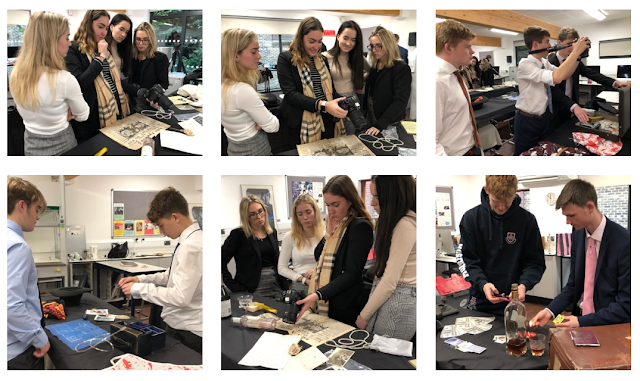
Good practice in editing: We are using Final Cut Pro and iMovie on the iMacs in the media studio. When uploading our footage, we should create a folder to keep the shots. These folders are called bins and the unedited footage from cameras are called rushes
Thursday, October 17, 2019
RESEARCH: TITLES
The Exorcist
- Production Company – Warner Brothers
- Director - William Friedkin
- Starring – ACTOR 1: Linda Blair
- ACTOR 2 : Max von Sydow
- ACTOR 3 : Ellen Burstyn
- Title : The Exorcist
- Starring – ACTOR 4 : Jason Miller
- ACTOR 5 : Jack MacGowran
- ACTOR 6 : Mercedes McCambridge
- ACTOR 7 : Lee J. Cobb
- Costume designer : Joseph Fretwell III
- Special make up effects supervisor : Dick Smith
- Sound designer : Jeff Schmidt
- Music : Mike Oldfield
- Film editor : Jordan Leondopolous, Norman Gay, Evan A. Lottman, Bud S. Smith
- Production designer : Bill Malley
- Director of photography : Owen Roizman , Billy Williams
- Executive producer: Noel Marshall
- Based on novel
- Screenplay : William Peter Blatty
- Producer : William Peter Blatty
- Director : William Friedkin


Get Out
- Production Company - Universal, Blumhouse/ QC Entertainment
- Associate production - Monkeypaw Production
- Film Director - Jordan Peele
- Title - Get Out
- Starring - Daniel Kaluuya, Allison Williams, Bradley Witford, Caleb Landry Jones, Stephan Root, Lakeith Stanfield, Catherine Keener, Lil Rel Howery, Erika Alexander, Marcus Henderson, Betty Gabriel, Richard Herd
- Casting - Terry Taylor, CSA
- Music supervisor - Christopher Mollere
- Music - Michael Abels
- Costume design - Nadine Haders
- Film Editor - Gregory Plotkin
- Production Designer - Rusty Smith
- Director of Photography - Toby Oliver, ACS
- Executive Producers - Raymond Mansfield, Couper Samuelson, Shaun Redick Jeanette Volturno
- Co-Producers - Beatriz Sequiera, Marcei A. Brown, Gerard DiNardi
- Producers - Sean McKittrick, Jason Blum, Edward H. Hamm J, Jordan Peele
- Writer & Director - Jordan Peele

Thursday, October 10, 2019
RESEARCH: DISTRIBUTION COLLAGE

- Film website
- Film posters
- Film trailers
- Cross promotion/ product tie-ins (like Heineken and James Bond in SkyFall and Spectre, Toyota and Star Wars)
- News articles, interviews, award ceremonies
Kezia Williams explained that, in a congested marketplace, a distributor's aim was too position a film in a way that it stood out for its target audience. Similarly, Chris Besseling offered me a series of insights into how distributors market a film's USP (Unique Selling Point) such as its star cast, its provenance (such as literary adaptation or biopic credentials), its awards and good reviews. Matt Smith of the FDA tells us that spend on digital has increased hugely. For example, trailers are now cut for portrait as the rise of watching videos on phone screens is extremely large. Digital includes all social media platforms (like Twitter, Facebook, Instagram and many more) that work as a synergetic whole in promoting a product. Matt Smith also refers to paid-for marketing as distinct from free publicity. Social media can generate viral marketing and publicise something for free!
I decided to do research on the movie Rocket Man which is a biography and fantasy film about Elton John and his rise to fame. For this movie, Kezia Williams was extremely accurate in saying that the distributers aim was to position the film to stand out to its target audience which in this case is extremely large as Elton John has elder fans from when he was in his prime time and also younger fans who look up to him. Because the film is based on a true story of the star, the marketing needed to be extremely clever and specific so people understood it was about Elton John and his story and so that people are also drawn in to watch it. For Blumler and Katz, audiences use media to gratify needs. Here, it is audiences as fans of particular talent, which in this case is Elton John.
FILM POSTERS
Firstly, the film company used film posters to promote the movie and to get it into the public eye and make people remember it to watch it in the future. The poster for the movie definitely sold the spectacle and visuals of the movie, showing him in one of his trademark flamboyant performance outfits and clearly have a blast singing and playing in front of a gigantic stadium crowd. The poster also has a purple tint as well as light shimmering all over the image, this connotes the bright fantastical tone of the film. A second poster of a close up of Taron Egerton's (Elton John) face, where his eyes are obscured by huge, dramatic glasses with a reflection of a piano in the glasses, signalling the movie is about a musician, who in this case is Elton John.
TRAILERS
The film released a teaser trailer and labeled the film as being 'based on a true fantasy' so is meant to create a kind of surrealistic framing of the story. By the teaser trailer showing off some of Elton John's most iconic outfits and styles, from glittery Yankees jerseys to the large cowboy hat and many more. Shown are clips of him as a young child to make clear to the audience that the movie is about him from his youngest days, or at least flashing back to them. The official trailer was released in late February and it offers a more complete look at the story, varying from John's beginnings as working as a pub musician when his name was Reggie, then also showing the height of his fame and glory, include the bad parts. The trailer presents his story as him trying to change his reality through the creation of one fantasy to another, like the wild costumers and other theatrical excesses. The trailer also includes more than a few hints at the sexuality he kept hidden in the early years, which clearly contributed to him feeling blocked from who he really was. The trailer is filled with his music which makes it a great selling point to old fans and also new ones. The trailer was an extremely successful way of advertising the movie, especially by first introducing a teaser trailer, then followed by the main one, drawing people in and keeping them interested.
ONLINE AND SOCIAL
On the movies official website, there is not a lot of information on there, however the display is somewhat original. The website includes interactive features helping to draw people in and become even more engaged in the movie and the story of Elton John. There is a feature called 'never ordinary' which is a photo-upload feature which allows visitors to add some sparkle to a headshot via a selection of colourful frames, Elton John glasses, text with declarations of strength or uniqueness. The end result can then be downloaded or shared on social networks which once again is a good marketing strategy as more people will hear about the movie when their friends share their personal image. Another interactive feature on the website is a quiz which people can complete. It is Called "What's your song", which has a personality quiz asking you a series of question to determine what Elton John song is the perfect one for you. Once again this is a very clever marketing strategy as it makes the target audience even more engaged in the movie when it is released. Additionally, there are more standard sections on the website, with videos, trailers and an option to stream the soundtrack, download or buy the album. This draws in viewers, making the movie more popular. On the website, Facebook is the only social media platform linked however for the movie, Twitter and Instagram profiles were created to have an interaction with the target audience and an official Giphy channel was created too. On Spotify, an official movie playlist has been created too, bringing in and engaging the target audience even after they have watch the film!
ADVERTISING AND CROSS PROMOTION
The first TV spot was released around the same time as the second (official) trailer, which cut down the story of John living a fantasy life into a shorter pitch for the audience while still including many key moments. Fandango announced in early may that it would give early access to watch the film to its VIP members two weeks prior to the release date in attempt to kickstart audience buzz and hype for the movie. This was an extremely exciting time for fans and made people even more excited to watch the film after hearing amazing reviews from other viewers! Just a few weeks before the movie came out, Elton John himself was used in an episode of American Idol where the contestants sang some of his biggest hits. This made the movie known to viewers of American Idol and was a good way of promoting the film once again, drawing more people in to watch it! Most online ads have used John in his sparkly Dodgers uniform as people are very familiar with Elton wearing this so it draws them in. Pre-roll ads on Youtube included advertising the movie itself and the specific soundtrack too, catering for both film lovers and music lovers. There were not many promotional partnerships, however one included Lucky Brand which created a collection of t-shirts inspired by the film and featured classic photos of Elton John. Another exclusive collection was offered by fashion retailer Mr Porter however those pieces were not as popular. Designer brand, Gucci, were involved in promotion because Elton John loved wearing their pieces so therefore was very significant in the role of publicity for the movie. People were drawn to this because if Gucci was promoting the movie, then it must be good.
The movie Rocketman was seen as a pivotal point for both Paramount and Taron Egerton as it was so successful so looked amazing upon the actor and the company. Appearing at Cannes Film Festival offered a moment where the general conversation about the film to be extremely positive and where there was extreme optimism that a potential Oscar could be won from this film! Cannes was extremely successful for promoting the film to the public, proving how successful and wonderful the film really is. The project so deeply involved the real people being portrayed which was had huge advantages on marketing where Elton John and Bernie Taupin and others have been available for interviews and appearances bringing more light towards the film.
Subscribe to:
Posts (Atom)